Disclaimer: This content is for informational purposes only and does not replace professional medical advice, diagnosis, or treatment. Always consult a qualified healthcare provider before beginning any new exercise program.
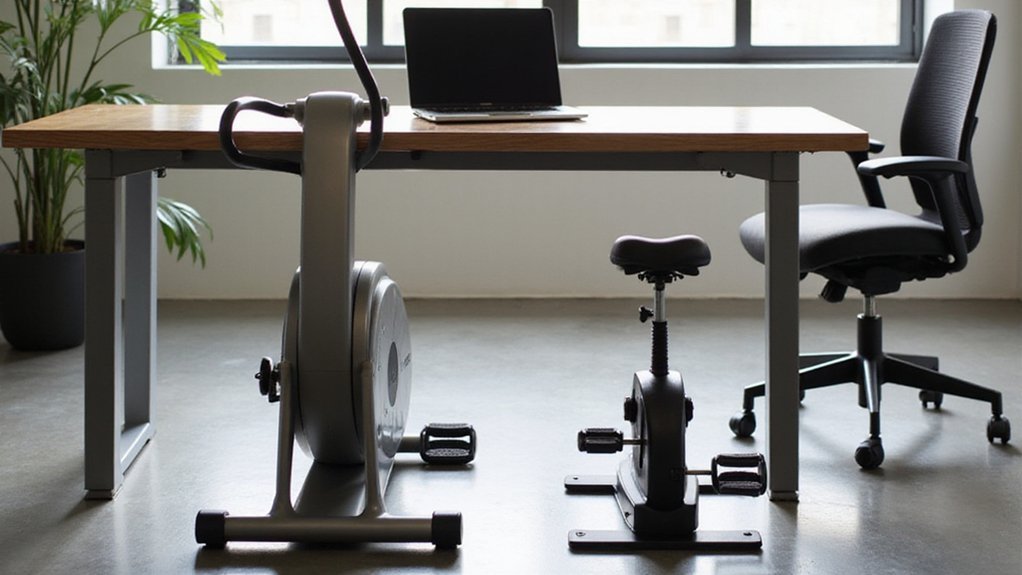
You’re probably wondering whether the extra calorie burn and muscle activation of an under‑desk elliptical outweigh the compactness and lower knee stress of a pedal exerciser. Data show ellipticals deliver roughly 30 % more calories (≈150 kcal/hr) and higher VO₂ (6.5 mL kg⁻¹ min⁻¹) while engaging glutes, quads, and hamstrings, but they take up more space, generate up to 35 dB of noise, and can increase joint shear. Pedals, on the other hand, are lightweight, fit tighter desks, and keep knee flexion between 0°‑130°, though they burn only 80–100 kcal/hr. The trade‑off hinges on your office layout, joint health concerns, and how much metabolic boost you need—let’s break down the numbers and ergonomics to see which device fits your all‑day sitting routine.
Key Takeaways
- Elliptical engages more muscle groups (glutes, quads, hamstrings) and burns ~30 % more calories per hour than a pedal exerciser.
- Pedal exerciser’s linear motion keeps knee angles 0°‑130°, reducing joint shear and patellofemoral stress compared with the elliptical’s 70‑90° flexion.
- Elliptical operates quieter (≤35 dB) and occupies a slightly larger footprint, while pedal exerciser is noisier (45‑50 dB) but more compact.
- Both devices fit under a desk, but the elliptical’s larger footpads and low‑profile design preserve chair mobility, whereas the pedal can block wheels.
- Choose based on goals: prioritize higher calorie burn and full‑leg activation with the elliptical, or opt for joint‑friendly, space‑saving, lower‑cost pedal exerciser.
Quick Comparison: Under‑Desk Elliptical vs. Pedal Exerciser for Office Use
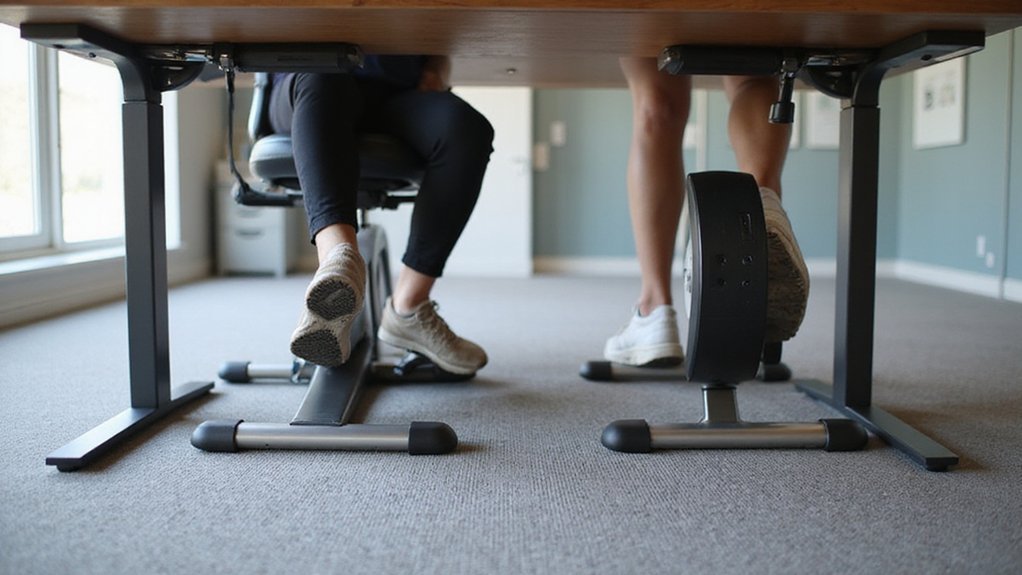
If you’re trying to stay active while glued to a desk, the under‑desk elliptical and the pedal exerciser differ sharply in motion, calorie burn, noise, and ergonomics.
The under‑desk elliptical offers smooth motion on an oval path, engaging glutes, quads, and hamstrings, while the pedal exerciser’s circular motion isolates the quadriceps.
At low resistance, the elliptical delivers about 150 calories per hour versus the exerciser’s 80–100 calories, reflecting higher metabolic demand.
Noise levels favor the elliptical, staying under 35 dB and minimizing desk vibrations, whereas the exerciser can produce a faint click‑clack at higher resistance.
Ergonomic posture benefits from the elliptical’s 90° knee angle, yet both devices maintain compact design for office use; the pedal exerciser weighs 3–4 lb, the elliptical 6–12 lb, and both support adjustable resistance for tailored workouts.
How Pedal Exercisers Keep Knees Safe (and How Ellipticals Compare)
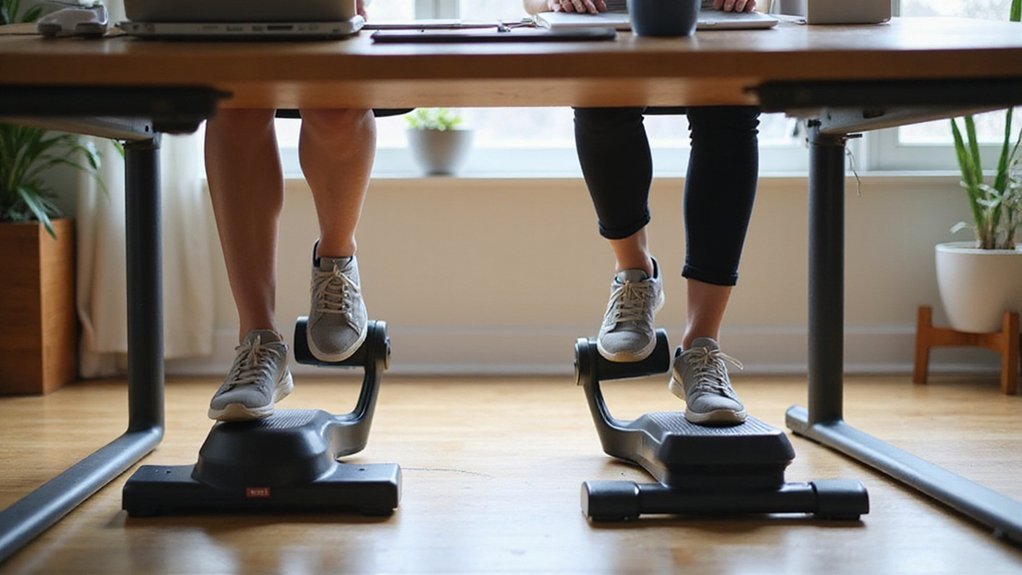
Because the pedal exerciser moves in a straight, low‑friction line, it keeps your knee joint angle between 0° and 130°, dramatically cutting shear forces and patellofemoral stress compared with the elliptical’s complex oval path.
The linear motion yields a low joint reaction force—15‑20 % lower than an under‑desk elliptical—so you stay knee safe even at higher resistance levels.
A flat foot position forces neutral ankle alignment, eliminating the toe‑out and valgus stress that an elliptical path can introduce.
You can start at 1 kg resistance for post‑operative rehab and incrementally increase load while knee flexion improves, without needing a larger foot‑track radius.
Data show comparable calorie burn (≈130 cal/h) but superior joint protection on the pedal exerciser.
Side‑by‑Side: Space, Noise, and Ergonomic Comfort at Your Desk
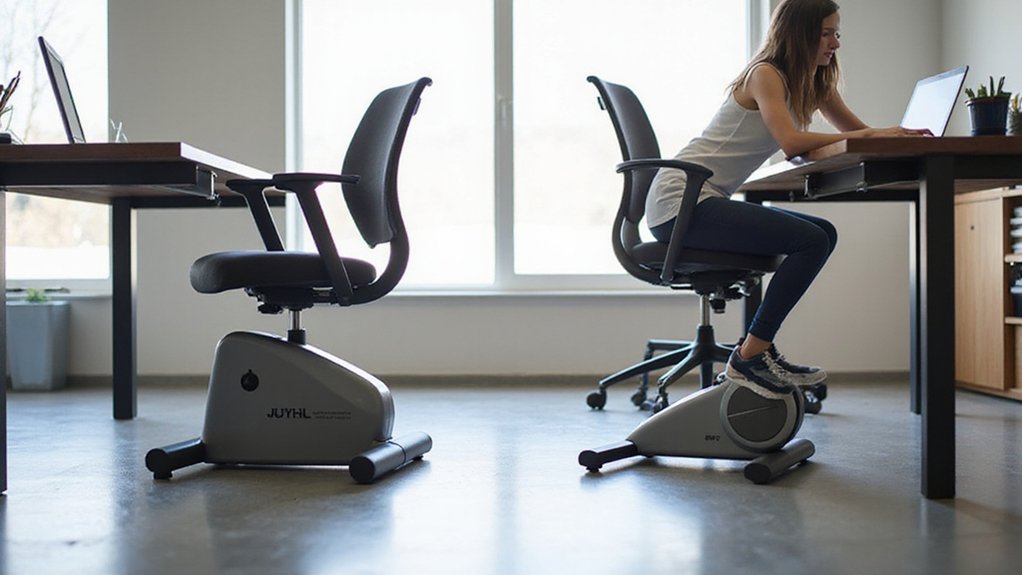
Keeping the knee‑friendly advantage of the pedal exerciser in mind, let’s compare how the two devices fit into a typical workstation.
The under‑desk elliptical occupies 12–14 in × 8–10 in of floor space, while the pedal exerciser squeezes into roughly 10 in × 6 in, giving it a clear edge for low desk clearance.
Magnetic resistance on the elliptical caps noise level at ≤ 35 dB, comparable to a quiet library; many pedal exercisers hit 45–50 dB, audible to nearby coworkers.
Ergonomic comfort differs: the elliptical’s 70–90° knee flexion angle and larger footpad size (≈ 4 in × 6 in) reduce hip rotation and foot fatigue, whereas the pedal exerciser’s ≈ 100° angle and smaller pads (≈ 3 in × 4 in) can promote forward lean.
Finally, the elliptical’s low‑profile design preserves chair mobility, while the bulkier pedal exerciser may block wheel movement, necessitating a stationary chair.
How Calorie Burn Differs Between Ellipticals and Pedal Exercisers
Even at the same effort level, an under‑desk elliptical burns roughly 30 % more calories than a pedal exerciser—about 150 kcal per hour versus 90–110 kcal.
The elliptical’s longer stride length and dual‑leg motion recruit quadriceps and glutes simultaneously, driving higher VO₂ (6.5 mL kg⁻¹ min⁻¹) and energy expenditure.
A pedal exerciser, even with added resistance, peaks at 4.8 mL kg⁻¹ min⁻¹ VO₂ and stays 10–15 % behind in calorie burn.
Because the elliptical’s motion is smoother, you can sustain longer session duration—up to 60 minutes—while pedal users typically stop after 15‑20 minutes, further widening the daily kcal gap.
- Stride length: elliptical > pedal, boosting muscle activation.
- Resistance impact: higher tension narrows but doesn’t erase the burn disparity.
- Session duration: longer elliptical workouts compound total energy expenditure.
How to Pick the Right Model for Your Budget and Fitness Level
The calorie advantage of an under‑desk elliptical over a pedal exerciser sets the stage for a practical buying guide: you now need to match that performance to what you can spend and how hard you plan to work.
First, set a budget: manual models stay under $150, while electric options range $200‑$250.
Compare elliptical resistance levels—magnetic or motor‑driven 6‑10 for cardio, knob‑type 1‑5 for light activity—to your fitness goal.
Check footpad size; a ≥4‑inch width and slight angle protect knees.
Prioritize silent operation if you share a quiet office.
Choose an LCD display or app sync for real‑time metrics.
Finally, decide between a under‑desk elliptical’s continuous motion and a pedal exerciser’s adjustable speed for interval training.
Daily Ergonomic Tips for Safe, Comfortable Use All Day
Where can you sit comfortably while pedaling for hours? Adjust chair height so hips sit slightly above knees, keeping a 90‑degree knee bend. Align desk height to eye level, use a wrist‑neutral tray, and avoid shoulder hunching.
Place a non‑slip mat under the desk, keep pedals within 12 in of the edge, and select a quiet, low‑resistance setting (1–3).
Take a 30‑second micro‑break every 20–30 minutes to stretch hamstrings, calves, and lower back, reducing joint load.
- Verify chair and desk heights maintain ergonomic posture.
- Use low‑resistance, quiet operation to limit joint load.
- Schedule micro‑breaks to prevent fatigue and shoulder hunching.
Conclusion
You’ll find the under‑desk elliptical burns roughly 30 % more calories (≈150 kcal/hr) and raises VO₂ to 6.5 mL kg⁻¹ min⁻¹, while the pedal exerciser stays under 100 kcal/hr and limits knee shear. Ellipticals need more desk space and generate ≤35 dB noise, whereas pedals are compact, lighter, and gentler on joints. Choose the elliptical if you prioritize metabolic gain and full‑leg activation; pick the pedal for tighter spaces and knee‑friendly, low‑impact work.