Disclaimer: This content is for informational purposes only and does not replace professional medical advice, diagnosis, or treatment. Always consult a qualified healthcare provider before beginning any new exercise program.
You spend hours hunched over a screen, feeling the stiffness creep in, and wonder if a tiny pedal machine could keep your blood flowing without stealing your focus. An under‑desk elliptical promises low‑impact cardio, modest calorie burn, and a subtle boost to circulation—all while you type. But it also demands space, posture discipline, and a sturdy chair, and the payoff may fall short if you crave a full‑body workout. Let’s break down who truly benefits, what the numbers look like, and the trade‑offs you need to weigh before deciding if it’s a smart addition to your workstation.
Key Takeaways
- They add low‑impact calorie burn (≈150 kcal/hr) and improve circulation, helping reduce stiffness and DVT risk during long sitting periods.
- Proper ergonomics are essential; 6–8 inches knee clearance and upright posture prevent neck, back, or knee strain.
- Benefits are modest compared to full‑body cardio, offering only lower‑body movement and limited workout variety.
- Drawbacks include potential knee bumpage, repetitive‑motion joint stress, and noise; choose magnetic‑drive models with stable pedals.
- Ideal for office or remote workers, seniors, and post‑surgery patients seeking short “movement snacks,” but not for those needing comprehensive fitness training.
What Is an Under‑Desk Elliptical and How Does It Work?
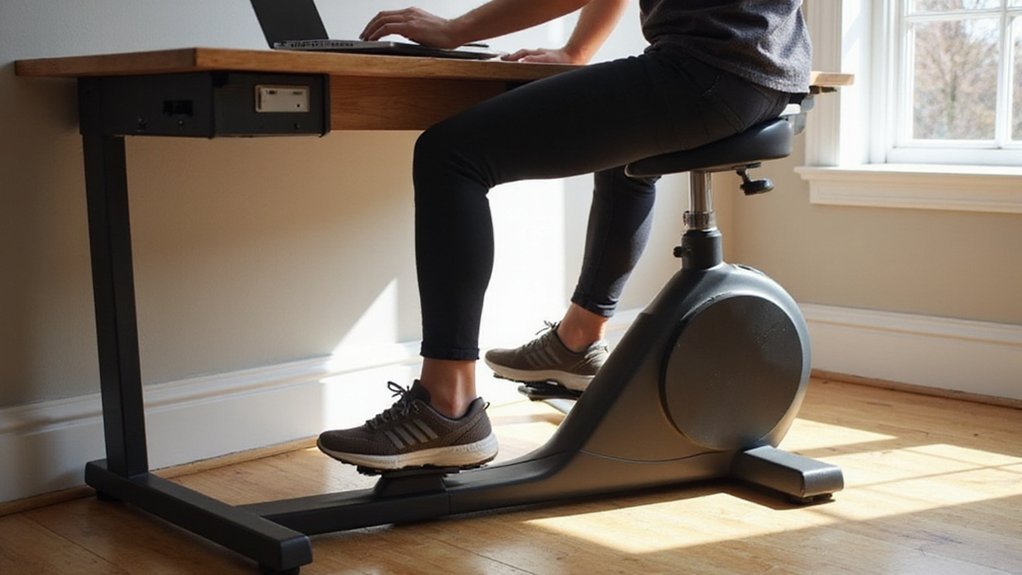
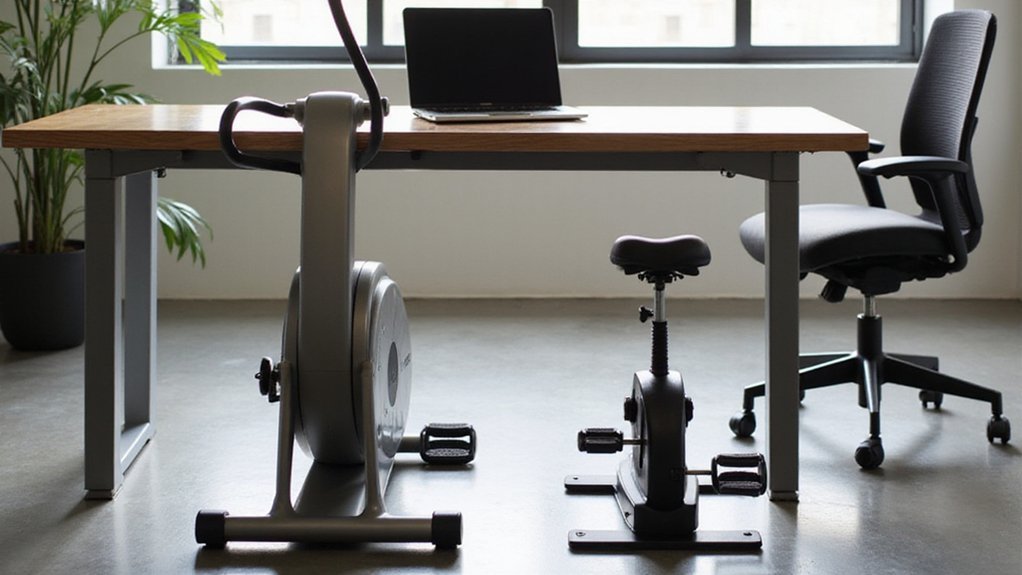
What’s an under‑desk elliptical? It’s a compact design machine that slides beneath a standard desk, letting you pedal while you work.
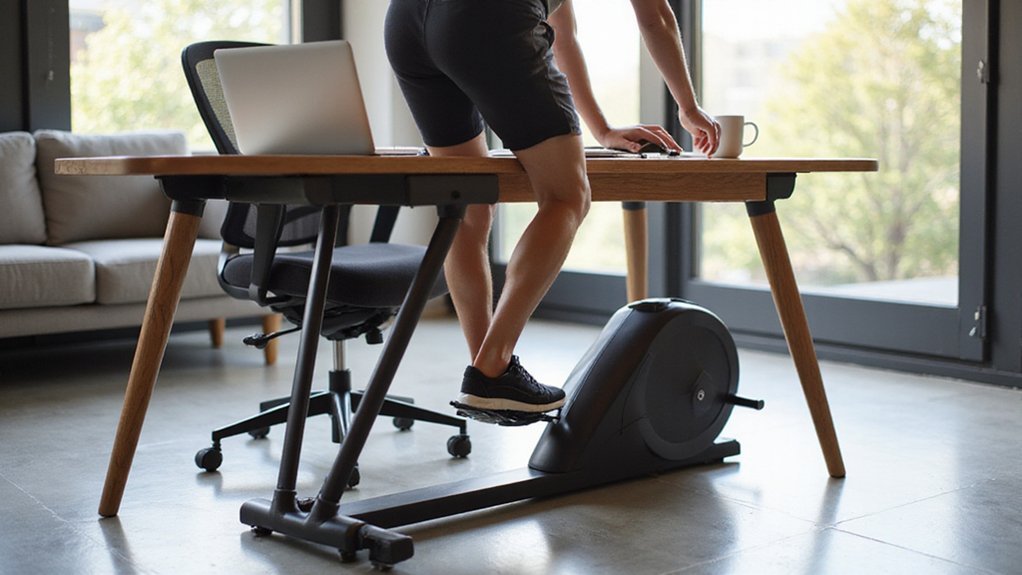
You engage in a smooth pedaling motion that mimics an oval path, keeping your upper body stationary for low‑impact movement.
The device uses magnetic resistance, often paired with friction options, and offers multiple resistance levels—typically eight or more—so you can dial intensity up or down.
A small LCD or app‑linked display tracks time, speed, steps, distance, and calories, averaging about 150 calories per hour.
Setup needs 6–8 inches of knee clearance and a stable chair or mat to prevent sliding, ensuring an upright posture with hips slightly above the knees.
This under‑desk elliptical delivers joint‑friendly exercise without disrupting desk work.
Who Benefits Most From a Desk‑Side Elliptical?
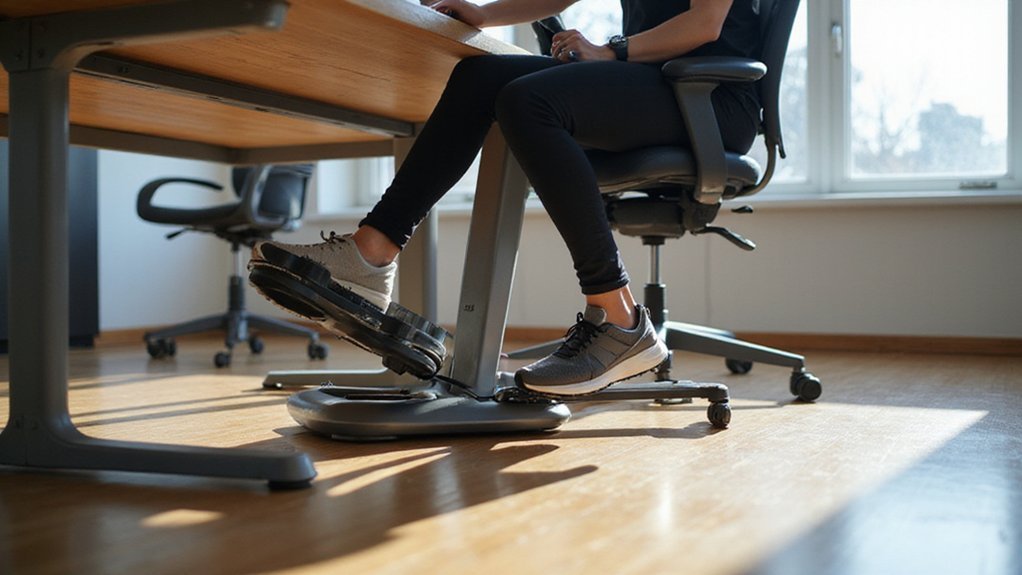
If you spend most of your day at a desk, you’ll reap the biggest gains—office workers logging six or more hours of sitting can burn roughly 150 kcal per hour of low‑impact pedaling, which improves circulation, eases stiffness, and adds about 750 kcal to weekly energy expenditure.
You, as a remote worker, can pair short 10‑minute sessions with video calls, boosting focus through better cerebral oxygen flow.
Seniors appreciate the knee‑friendly, low‑impact exercise that reduces DVT risk while sparing cartilage.
For injury recovery, especially post‑knee surgery, the elliptical’s forward‑and‑backward motion follows physical‑therapy protocols, maintaining flexibility and limiting swelling.
Finally, anyone seeking modest calorie burn without a full‑body workout can treat the device as a “movement snack,” contributing steady energy expenditure while you work.
How Many Calories Can You Burn With an Under‑Desk Elliptical While Working?
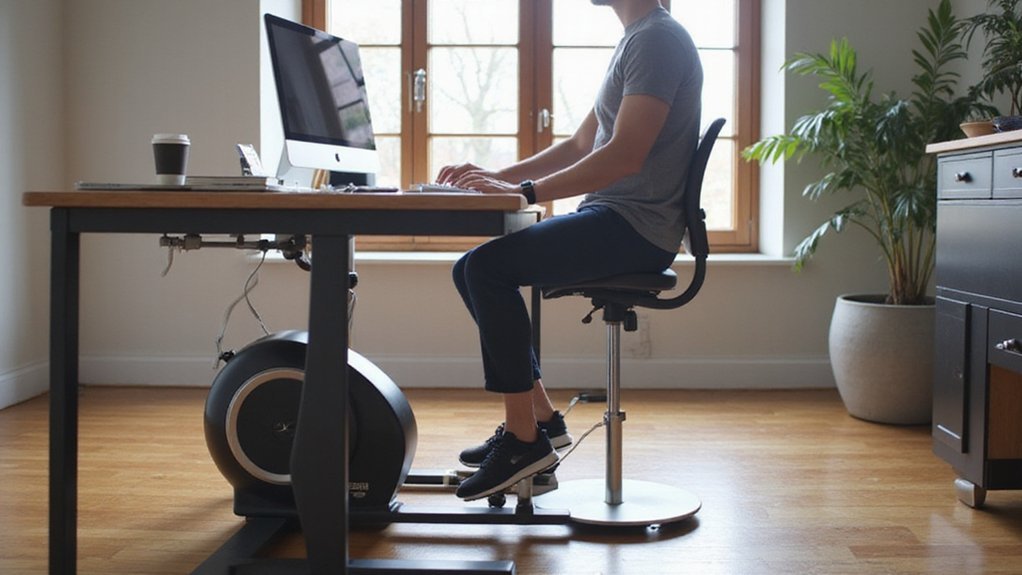
Even though you’re glued to your desk, a typical under‑desk elliptical can still torch roughly 150 calories per hour at low resistance—about 2.5 calories each minute—and up to 4 calories per minute when you crank the resistance up. At moderate resistance (levels 3‑4) you’ll burn about 75 calories in a 30‑minute session, comparable to a leisurely 10‑minute walk. Manual units can push the burn to ~179 cal/hr, while motorized models hover near 91 cal/hr. Your actual output varies ± 20 % with body mass, speed, and resistance. Intermittent 5‑minute bouts across an 8‑hour day total 50‑200 calories, modestly boosting daily energy expenditure.
| Session | Calories Burned |
|---|---|
| 5 min low resistance | 12.5 cal |
| 5 min moderate resistance | 20 cal |
| 30 min moderate resistance | 75 cal |
| 1 hour low resistance | 150 cal |
| 1 hour high resistance | 240 cal |
What Health Advantages Come From Using an Under‑Desk Elliptical at Your Desk?
Burning about 150 calories per hour shows just one side of the story; the real win is how an under‑desk elliptical boosts your health while you work.
It ramps up lower‑body blood flow, cutting deep‑vein thrombosis risk and easing leg stiffness after long sitting.
The steady calorie burn adds modest energy expenditure without breaking focus, while enhanced oxygen delivery sharpens mental clarity.
Low‑impact motion keeps knee and ankle joint flexibility high, supporting cartilage health and reducing post‑surgery swelling.
Regular micro‑movement also nudges you toward daily activity guidelines, and the subtle rhythm encourages posture improvement by engaging core stabilizers.
Together, these effects turn idle desk time into a proactive health habit.
What Drawbacks, Risks, and How to Avoid Them?
While an under‑desk elliptical can turn idle time into light activity, its drawbacks deserve attention.
You may notice knee‑bumpage if your desk or chair height forces your knees to hit the work surface; adjust the workstation so knees clear the desk and hips sit slightly above them.
Improper posture—slouching or leaning forward—creates neck and back strain, so sit upright and keep shoulders relaxed.
Cheaper units often emit noise or develop pedal slip after extended use; opt for magnetic‑drive models with thick front‑lip pedals and test for quiet operation.
Joint stress can flare up in knees, ankles, or hips, especially at high resistance levels; start low, limit sessions to 3‑5 minutes, and consult a professional if you have pre‑existing issues.
Finally, fitness trackers typically miss elliptical motion, leading to inaccurate calorie tracking; rely on the device’s app or manually log resistance for better estimates.
How to Choose the Right Model for Your Workspace & Budget?
If you measure the gap between your desk and knees first, you’ll instantly know whether a given under‑desk elliptical fits without causing knee‑bumpage. Aim for at least 12‑14 inches of clearance space, then check the magnetic drive’s noise rating; models under 45 dB keep video calls quiet.
Compare resistance levels: manual units boost cardio output (≈ 180 cal/hr) while motorized ones deliver smoother motion for long “movement snack” sessions.
Align price range with features—budget ($60‑$120) lacks displays, mid‑range ($150‑$250) adds LCD readouts, high‑end ($300+) offers app integration and auto‑mode presets.
Guarantee foot stability by choosing wide, lip‑bordered pedals and pair the elliptical with a non‑rolling chair and a non‑slip mat to prevent wobble. This systematic check matches your workspace constraints and budget without compromising performance.
What Is the Best Ergonomic Setup for Safety?
When you set up your under‑desk elliptical, start by aligning your chair so your hips sit just above your knees, creating a roughly 90° thigh angle that keeps knees clear of the desk and eases joint strain.
Adjust chair height until your feet are flat on the pedals and your spine stays upright.
Place a non‑slip mat under the elliptical to prevent sliding, and keep the pedals at least 2–3 inches from the desk surface.
Set the monitor at eye level and use a keyboard tray that holds elbows at a 90° angle, reducing forward lean.
Periodically check adjustable resistance, aiming for a comfortable 2–4 setting, and guarantee the foot‑lip holds your feet flat without slippage.
This configuration maximizes safety and minimizes strain.
How Can I Integrate an Under‑Desk Elliptical Into My Workday Without Distraction?
Even a modest resistance setting (level 2‑3) lets you pedal while checking email or on calls without jerking your head, so you stay focused and productive. Set the desk so knees have 2‑3 inches of clearance and sit upright with hips slightly above knees; this ergonomic posture prevents slouching that could break focus. Keep the LCD or phone app in peripheral view, and use a timer for 10‑minute pedal blocks followed by 5‑minute standing or stretching breaks. Pair the under‑desk elliptical with low‑cognitive‑load tasks like spreadsheet updates or webinars to preserve productivity.
| Time Block | Action |
|---|---|
| 0‑10 min | Pedal, level 2‑3, read email |
| 10‑12 min | Stand, stretch |
| 12‑22 min | Pedal, level 2‑3, on call |
| 22‑24 min | Stand, stretch |
| 24‑34 min | Pedal, level 2‑3, data entry |
Read routine use of adjustable resistance levels, strategic breaks, and ergonomic setup lets you integrate the under‑desk elliptical seamlessly while maintaining focus and productivity.
When Is an Under‑Desk Elliptical Not Worth the Investment?
Your smooth, low‑impact pedaling works great for staying productive, but it falls short when you’re aiming for serious calorie burn, joint‑friendly workouts, or full‑body conditioning.
- Cal burn: ~150 kcal/hr is far below a treadmill’s output, so weight‑loss goals suffer.
- Joint pain: Repetitive motion can aggravate knee, ankle, or hip injuries despite low‑impact claims.
- Ergonomics: Tall desks or low chairs limit knee clearance, causing uncomfortable bumpage and poor posture.
- Cost: $100‑$300 (or $160 for a basic Cubii) rarely justifies modest energy expenditure versus cheaper alternatives.
- Limited workout versatility: Lower‑body focus and no upper‑body resistance make it insufficient for full‑body cardio or strength training.
If any of these red flags apply, the elliptical isn’t a worthwhile investment.
Conclusion
If you need low‑impact movement, modest calorie burn and better circulation while staying at your desk, an under‑desk elliptical can be a smart addition—especially for office workers, seniors, or post‑surgery patients. Just make sure you have enough knee clearance, a stable chair, and an upright posture to avoid joint strain. The trade‑offs are limited upper‑body work, occasional noise, and a cost that may not suit those chasing full‑body cardio. In the right context, it’s worth it.