Disclaimer: This content is for informational purposes only and does not replace professional medical advice, diagnosis, or treatment. Always consult a qualified healthcare provider before beginning any new exercise program.
You’re trying to decide whether an under‑desk elliptical or a walking pad fits your workstation best. The elliptical slides under most desks, stays under 5 dB, and adds minimal vibration, so Zoom calls stay clear. The walking pad needs a 4‑ft clearance, hits 55‑65 dB, and can shake the desk, but it offers a more natural stride. Both burn roughly the same calories, yet their footprints, noise profiles, and costs differ enough to tip the balance depending on your space, budget, and workflow.
Key Takeaways
- Elliptical fits under standard desks with minimal height clearance, while a walking pad needs 4 ft front clearance and a standing desk.
- Elliptical motor noise stays below 45 dB, causing negligible distraction; walking pad noise rises to 55‑65 dB, potentially disrupting calls.
- Elliptical provides low‑impact, seated cardio at ~150 kcal/hr; walking pad offers weight‑bearing cardio up to ~180 kcal/hr at higher speeds.
- Elliptical is lighter (~18 lb) and cheaper ($160‑$200), making relocation and budgeting easier than a heavier, $300‑$600 walking pad.
- For seated work and joint‑sensitive users, elliptical is safer and more ergonomic; walking pad suits standing‑desk users seeking higher intensity.
What Is an Under‑Desk Elliptical? How Does It Work?
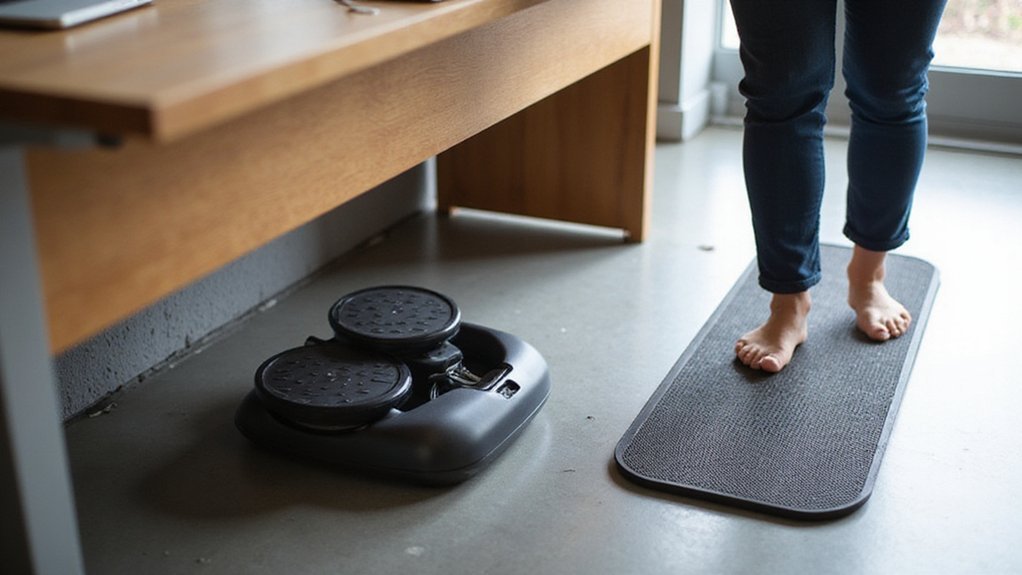
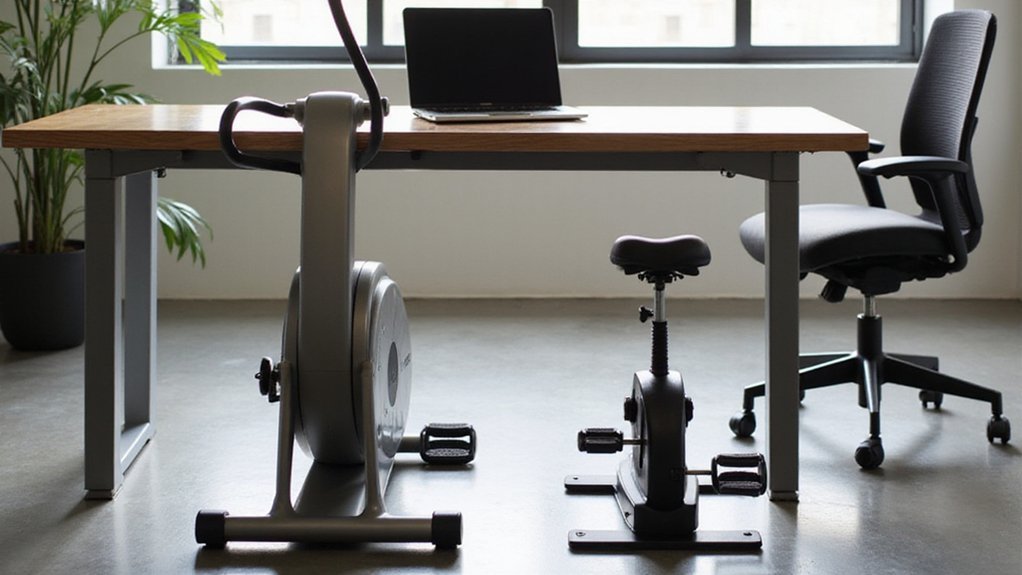
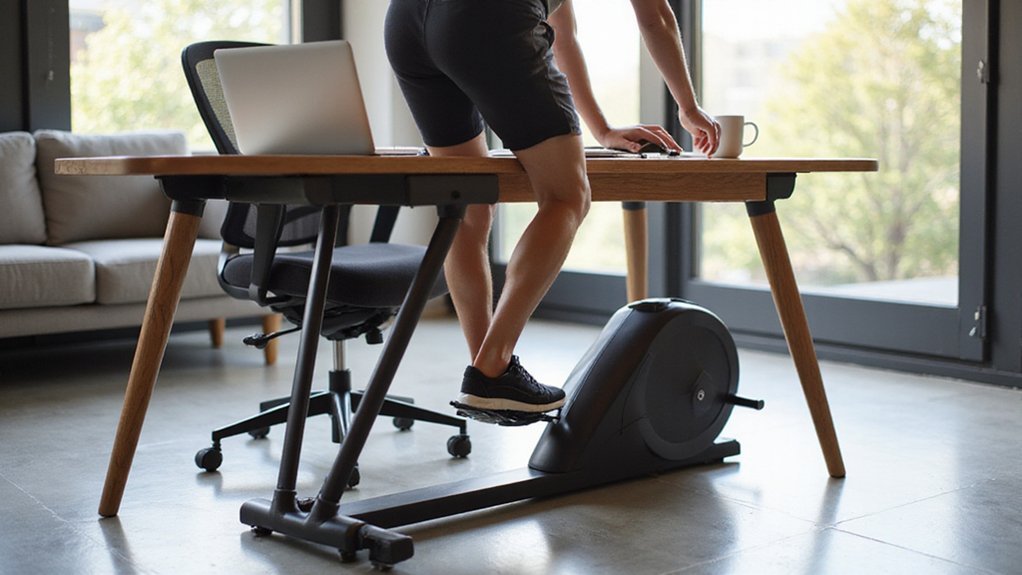
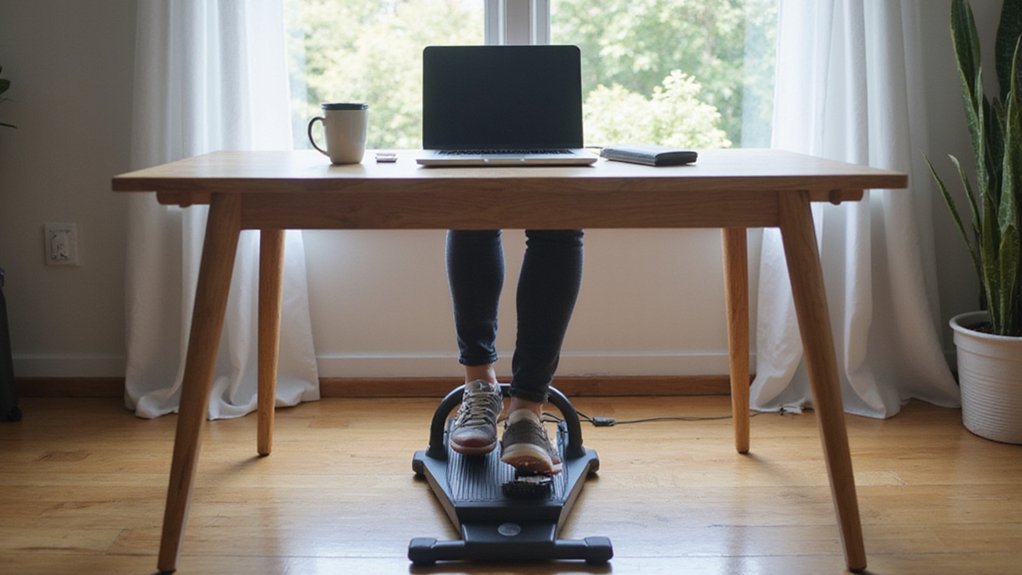
When you place an under‑desk elliptical beneath your workstation, you get a compact, motor‑assisted pedaling platform that lets you move while you type.
The device fits within a 21.7″ × 19.7″ × 9.7″ envelope, so desk height remains unchanged and the machine stays portable for storage.
Its circular pedaling motion delivers low‑impact exercise, reducing joint stress compared with standing.
Adjustable resistance—typically eight to twelve levels—lets you modulate effort without altering speed, directly influencing calorie burn, which averages 150 kcal per hour for a 75 kg user.
Wide, lip‑guarded foot platforms prevent slippage, while quiet operation stays under 45 dB, preserving call clarity and coworker focus.
This technical balance of size, resistance, and ergonomics makes the under‑desk elliptical a precise, desk‑friendly fitness solution.
What Is a Walking Pad? Why Is It Popular for Standing Desks?
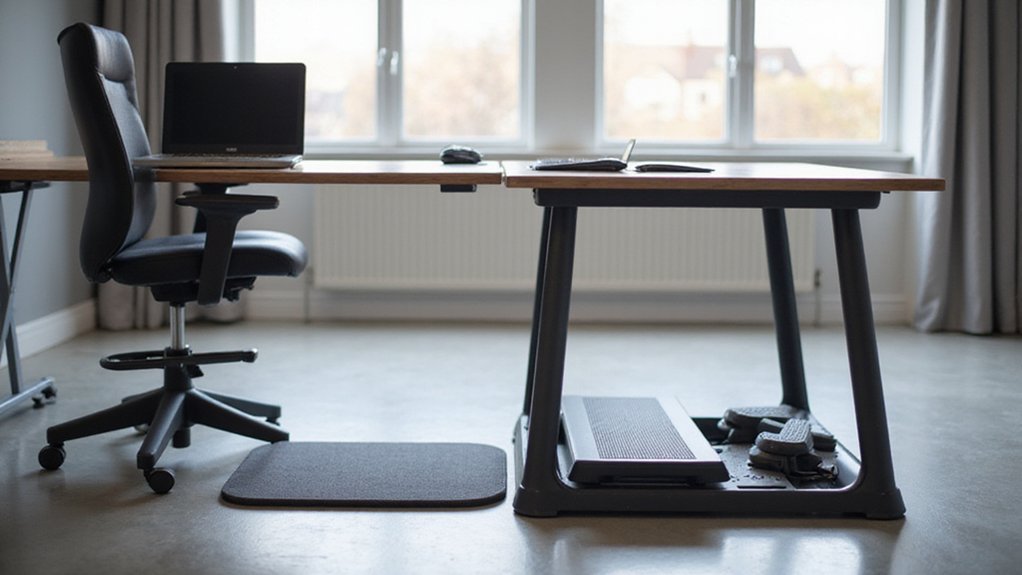
Unlike the compact, motor‑assisted pedaling of an under‑desk elliptical, a walking pad is a low‑profile, foldable treadmill that slides beneath a standing desk. Its compact design—56.8″ × 20.3″ × 4.9″ unfolded, 32″ × 20.3″ × 4.9″ folded—lets you keep a home office tidy while a quiet motor (< 50 dB) guarantees calls stay uninterrupted. By delivering weight‑bearing activity at 0.5‑4 MPH, it boosts calorie burn (≈150 kcal/hr at 3 MPH) and cardiovascular benefits compared with seated work, making it a logical companion for a standing desk.
| Feature | Spec | Benefit |
|---|---|---|
| Size (unfolded) | 56.8″ × 20.3″ × 4.9″ | Fits under most desks |
| Speed range | 0.5‑4 MPH | Gentle walking while typing |
| Noise level | < 50 dB | Quiet for shared spaces |
Space Requirements for Under‑Desk Elliptical vs Walking Pad
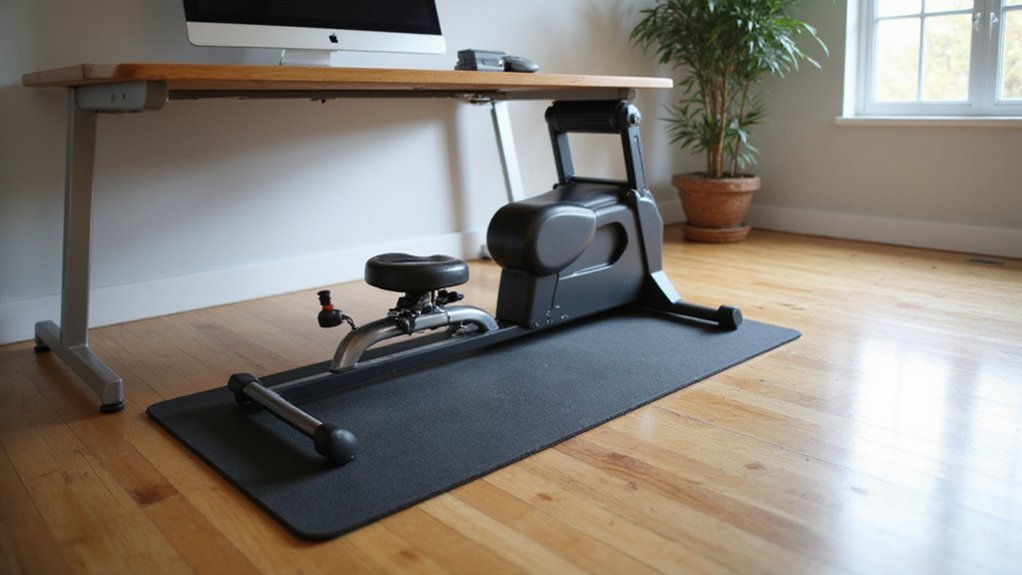
Because the elliptical’s compact 21.7″ × 19.7″ × 9.7″ footprint slides directly under most desks, it needs only a modest 275‑sq‑ft studio for storage and a clearance of about 10″ in height.
The under‑desk elliptical’s compact size lets you place it beneath a standard 25″ × 25″ work surface, requiring minimal desk clearance and a clear height of roughly 10″.
In contrast, the walking pad’s folded footprint of 32″ × 20.3″ × 4.9″ expands to 56.8″ × 20.3″ × 4.9″ when unfolded, demanding about 5 sq ft of floor space and a 4‑ft front clearance for safe stepping.
Its 55 lb weight also increases the room needed for storage and relocation compared with the elliptical’s 17.6 lb weight.
Consequently, the walking pad needs a dedicated floor area and a higher standing desk, while the elliptical fits comfortably under most desks with limited space requirements.
Quietness Comparison: Calls vs. Open‑Office Noise
If you’re on a Zoom call in an open‑plan office, the Cubii Move’s ~45 dB(A) motor stays well below the typical 55‑60 dB(A) background, making it virtually inaudible, whereas the Walking Pad S1’s belt and motor hit 55‑65 dB(A) at 3 MPH and can be heard through a headset.
| Device | Placement | Noise Impact |
|---|---|---|
| Cubii Move | Under‑desk placement | Adds <5 dB(A) to ambient noise, stays under office hum |
| Walking Pad S1 | Folding treadmill design | Raises ambient levels 8‑10 dB(A), transmits vibration through floor |
| Typical Open‑Office | Ambient noise ~50 dB(A) | Baseline for comparison |
Your Zoom calls benefit from the elliptical’s quietness because motor noise remains isolated, while the walking pad’s motor noise and vibration transmission can breach headset mics and disrupt the office hum. The contrast in dB(A) levels shows the elliptical preserves background noise, whereas the walking pad adds perceptible sound that may exceed comfortable listening thresholds for nearby colleagues.
Calorie Burn: Under‑Desk Elliptical vs Walking Pad
While both devices let you stay active at your desk, the walking pad burns considerably more calories than the under‑desk elliptical; a 75 kg user burns about 150 kcal in 30 minutes at 3 MPH on the pad versus roughly 80 kcal on the Cubii Move, and at the pad’s top speed of 4 MPH the expenditure climbs to 180 kcal per half‑hour, roughly double the elliptical’s maximum of ~100 kcal.
The walking pad’s weight‑bearing nature raises heart rate, producing a 20‑30 % higher cal burn versus the low‑impact, seated under‑desk elliptical. Its calorie expenditure scales linearly with intensity, while the elliptical’s resistance levels yield a flat ~150 kcal per hour.
For desk work, the walking pad delivers roughly double the hourly calorie expenditure, making it the more efficient choice.
Who Benefits From Low‑Impact Joint‑Friendliness?
When you prioritize joint‑friendliness, the under‑desk elliptical serves seniors, post‑surgical patients, and anyone with chronic musculoskeletal pain far better than a walking pad, because its gliding motion reduces joint stress by up to 90 % compared with weight‑bearing treadmill walking. The low‑impact design protects osteoarthritis‑affected joints, accommodates knee replacement and hip replacement recovery, and eases chronic lower‑back pain and neck pain without adding spinal load. For users with balance issues or Parkinson’s disease, the wide, lip‑protected pedals lower fall risk while still engaging major muscle groups. Athletes in active recovery benefit from sustained circulation and range of motion without metabolic strain.
| User Group | Key Benefit |
|---|---|
| Seniors with osteoarthritis | 90 % joint‑stress reduction |
| Post‑surgical (knee/hip replacement) | Impact‑free healing environment |
| Chronic lower‑back/neck pain sufferers | Seated motion, spinal load relief |
| Balance‑impaired or Parkinson’s disease | Secure pedals, fall risk mitigation |
| Active‑recovery athletes | Circulation, range of motion, low metabolic cost |
Ergonomic Fit: Posture, Knee Clearance, Typing
Because an under‑desk elliptical sits only about 9.7 inches low, it leaves roughly 4–5 inches of knee clearance under a typical 25‑inch desk, letting you keep your feet comfortably planted while maintaining a naturally upright torso; in contrast, a walking pad demands a standing height of 30–36 inches, often forcing you to raise the desk or hunch forward, which increases neck strain and disrupts typing alignment.
The elliptical’s seated motion keeps your posture stable, hips slightly above knees, and eliminates forward tilt, preserving joint comfort and a consistent wrist‑hand line for typing.
Its vertical vibration stays below 0.2 mm, so desk height remains steady.
The walking pad’s belt introduces up to 1 mm vibration, shifts center of mass, and can compromise ergonomic fit, especially for users with limited knee flexion.
Cost, Durability & Maintenance Overview
If you compare the price tags, the under‑desk elliptical comes out ahead—models like the Cubii Move sit around $160‑$200, whereas walking pads such as the S1 range from $300‑$600.
The elliptical’s footprint (~22″ × 20″) and weight (17‑18 lb) keep it lightweight and easy to relocate, while the walking pad’s larger footprint (≈57″ × 20″) and 55 lb mass demand more floor space and handling.
Warranty periods differ: under‑desk ellipticals typically receive 1‑2 years with replaceable pedals, whereas walking pads offer a 1‑year warranty covering belt and motor.
Maintenance on ellipticals is minimal—cleaning the pedal track and occasional battery swaps—while walking pads require belt tension checks, lubrication, and motor inspection.
Performance lifespan favors ellipticals, sustaining up to 5,000 hours versus 2,000‑3,000 hours for walking pads.
Decision Matrix: Match Style, Goals & Budget
Although your work posture, fitness goals, and budget differ, a simple decision matrix can pinpoint whether an under‑desk elliptical or a folding walking pad best fits your desk setup.
Compare the compact footprint of an under‑desk elliptical (≈21.7″ × 19.7″) against the larger desk‑space demand of a walking pad (≈32″ × 20.3″ folded, 56.8″ × 20.3″ in use).
Align budget limits: under‑desk elliptical models stay under $300, while a comparable walking pad starts at $300.
Match fitness goals: resistance levels and quiet operation (<40 dB) favor low‑impact calorie burn (~150 kcal/hr), whereas higher speed on a walking pad boosts step count and cardio, delivering 30‑40 % more calorie burn.
- Seated work → under‑desk elliptical, low impact, quiet, $160‑$200
- Standing desk → walking pad, higher speed, step count, $300‑$600
- Space‑tight office → compact footprint, under‑desk elliptical
- Budget‑first approach → stay under $300 with elliptical, walking pad exceeds budget
Conclusion
You’ll find the under‑desk elliptical outperforms the walking pad for desk work. Its 21.7 × 19.7 inch footprint fits under most tables, adds only 5 dB noise, and eliminates vibration, preserving Zoom call quality. At ~150 kcal/hr it delivers meaningful cardio while you type, and at 18 lb and under $200 it stays portable and affordable. The walking pad’s larger clearance, louder noise, and higher cost make it better suited for standing‑desk users who prioritize stride length over quiet, low‑impact exercise.