Disclaimer: This content is for informational purposes only and does not replace professional medical advice, diagnosis, or treatment. Always consult a qualified healthcare provider before beginning any new exercise program.
You’ve probably wondered whether a push‑up board or a set of handles will give you the best home workout, and the answer isn’t one‑size‑fits‑all. Boards spread wrist pressure and lock you into a stable platform, while handles keep your wrists neutral and let you shift hand placement for progressive overload. Each option trades off space, cost, and comfort, so the choice hinges on your wrist health, the room you have, and the training goals you’re chasing. The details ahead will help you decide which tool aligns with your routine.
Key Takeaways
- Handles provide a neutral wrist position and extra chest drop, increasing pectoral activation by ~12 % compared to boards.
- Boards distribute pressure over a larger area, reducing peak wrist stress to ~0.5 MPa and lowering torque for hyperextension sufferers.
- Handles are compact (≈0.3 ft³) and travel‑friendly, while foldable boards occupy less space than fixed boards but still require a dedicated spot.
- Boards lock hand angles in preset slots for quick grip changes; handles allow fine‑tuned hand placement for progressive overload.
- For budget‑conscious home gyms, handles cost $15‑$25 and need minimal space, whereas boards cost $20‑$35 and need a stable surface to prevent rolling.
What Are Push‑Up Boards and Push‑Up Handles?
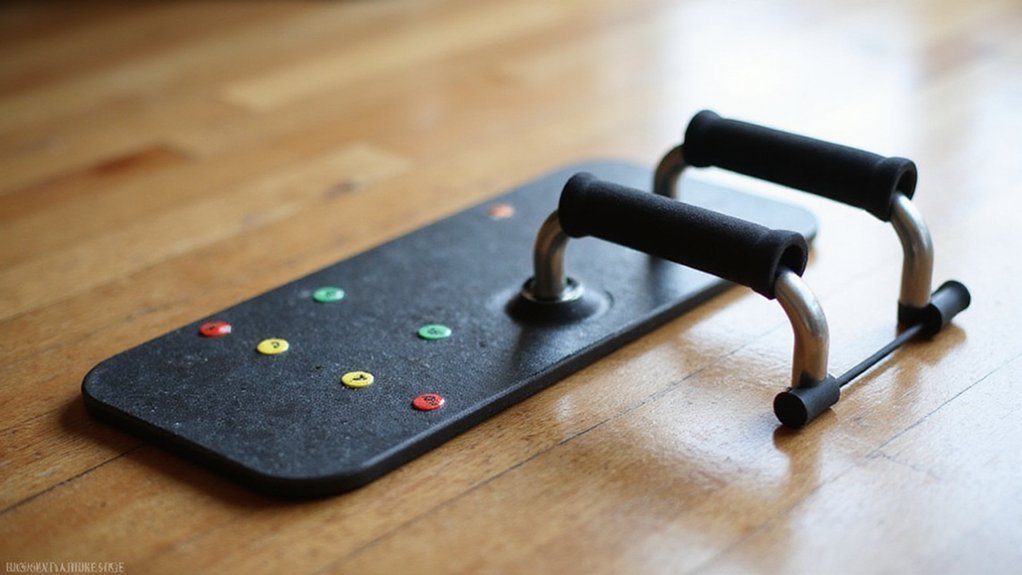
When you’re looking to amp up your home workout, push‑up boards and push‑up handles are the two most popular accessories that let you target muscles more precisely.
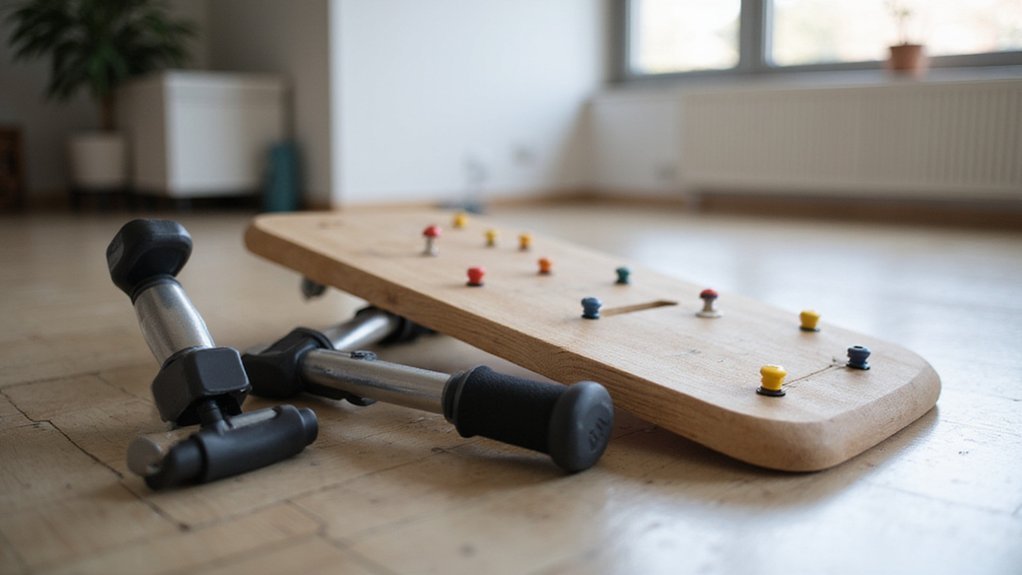
A push‑up board is a flat platform with multiple grip slots, letting you shift hand placement and angle for varied muscle targeting. You can choose narrow, wide, or angled slots to hit chest, shoulders, or triceps differently.
A push‑up handle, on the other hand, is a single bar that lifts your hands off the floor, creating a neutral wrist position and greater range of motion while reducing wrist strain. Handles are compact, portable equipment that lets you change hand placement quickly, whereas boards occupy more floor space and may still require some wrist extension.
Both tools support progressive overload, but handles excel in wrist comfort and flexibility.
How Do Push‑Up Boards and Handles Differ in Range of Motion?
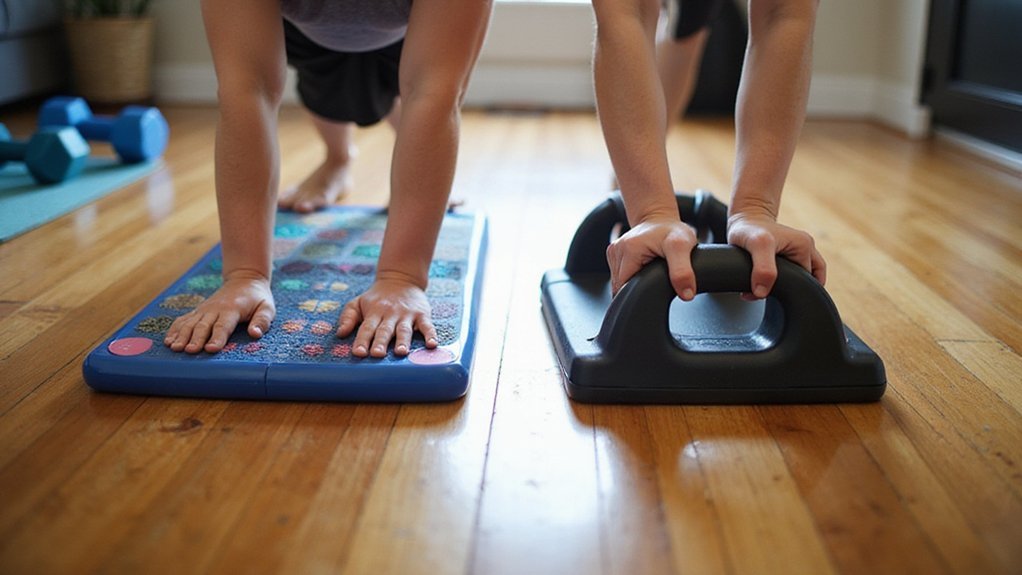
Unlike the board’s fixed slots, push‑up handles let your wrists stay neutral and your chest drop a few centimeters farther, giving you a deeper stretch each rep. Handles provide a full range of motion, increasing chest depth and upper body muscles activation, while boards keep a flexed wrist and limit shoulder rotation. Adjustable handles let you shift hand positions for targeted stimulus, whereas board slots lock you into preset angles that cap depth. The extra 2–3 cm of travel translates to ~12 % greater activation of the pectoralis major, making handles the clear choice for maximizing range of motion.
| Feature | Push‑Up Board | Push‑Up Handles |
|---|---|---|
| Hand positions | Fixed slots (wide, narrow, diamond) | Adjustable, free‑floating |
| Wrist angle | Flexed wrist | Neutral wrist |
| Chest depth | Limited | Deeper (2–3 cm extra) |
| Shoulder rotation | Limited | Greater, requires control |
| Muscle activation | Standard | Greater activation |
Which Is Easier on the Wrists: Boards or Handles?
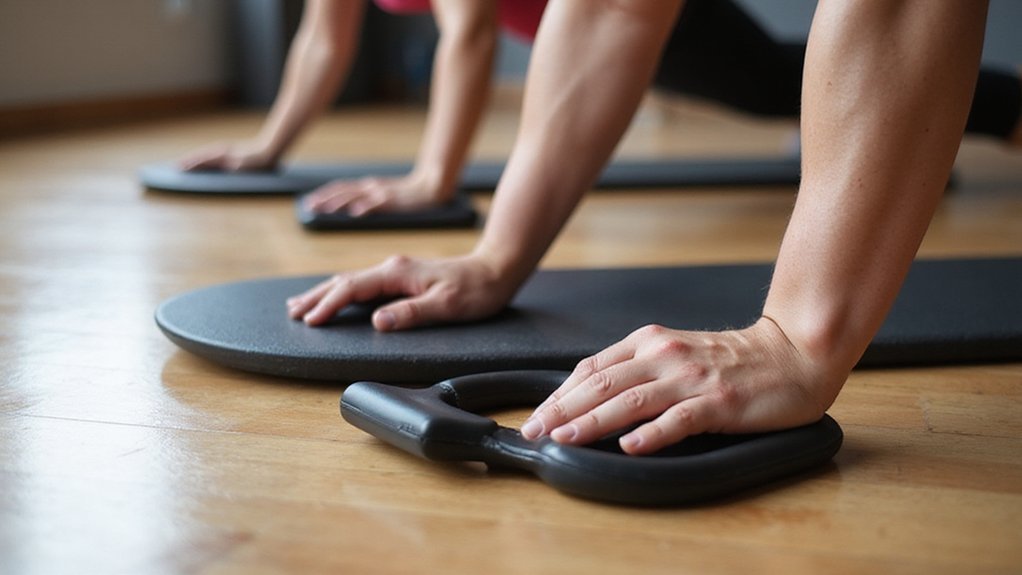
If you’re worried about wrist strain, a push‑up board usually feels easier than handles because its flat platform keeps the wrist neutral and spreads the load over a larger area. The board’s ergonomic design reduces hyperextension risk and cuts peak pressure from ~0.8 MPa to ~0.5 MPa, delivering noticeable comfort during home workouts.
Handles, while useful for grip strength, keep the wrist in slight extension and maintain pressure around ~0.6 MPa, offering only a modest 10‑15 % torque reduction. Your wrist will appreciate the board’s superior load distribution and neutral position, especially if you’ve experienced discomfort or hyperextension issues.
- Flat surface → neutral position
- Larger contact area → lower pressure
- 2‑3× more comfort for hyperextension sufferers
- Consistent reduction in wrist torque for home workouts
How Do Push‑Up Boards Compare in Portability and Storage?
Even if you’ve chosen the board for wrist comfort, you’ll also love how easy it’s to store and transport.
A typical push‑up board folds flat, giving you a compact, lightweight package that slides into a drawer or gym bag, and its flat profile reduces the footprint by up to 70 %.
You’ll find it travel‑friendly, taking only about 0.1 ft³ of space, compared with the bulkier 0.3 ft³ handle set.
The board’s foldable design lets you stack it with other accessories, making it space‑efficient for apartments or small home gyms.
Because it’s made of wood or plastic, it stays stable without a dedicated shelf, while the heavier metal handles demand a sturdier surface.
Common Safety Mistakes With Push‑Up Boards and Handles
When you grip the handles too tightly or let your wrists bend past a comfortable angle, you’re loading the tendons with up to 15 % more stress, which quickly turns a simple workout into a potential injury. To stay safe, keep your wrist neutral, maintain a straight body line, and set up a stable base before you start. Use knee‑based push‑ups to master balance, then progress with a controlled tempo (2 seconds down, 1 second up). Avoid wrist deviation and board roll by spacing the handles shoulder‑width apart and ensuring the base is at least 15 cm wide. Remember, over‑use strain spikes when you rush reps, so limit each set to 12–15 reps.
- Letting hips sag or butt lift, breaking the straight body line
- Placing the board too narrow, causing board roll and wrist sprains
- Skipping knee‑based push‑ups, raising shoulder impingement risk
- Rushing tempo, leading to over‑use strain of the shoulder joint
Top Push‑Up Variations for Boards vs. Handles (and Targeted Muscles)
Although boards give you instant, preset grip widths, handles let you fine‑tune hand placement and angle on the fly, unleashing a broader range of muscle‑targeting push‑up variations. With a hand‑up board you can jump between wide, narrow, and diamond slots, each shifting chest activation and triceps load. Push‑up handles, however, let you adjust hand placement by a couple of centimeters each set, enabling progressive overload and engaging forearm stabilizers while you explore a deeper range of motion.
| Variation | Primary Target Muscle Groups |
|---|---|
| Wide‑slot board push‑up | Lower pectoralis, triceps |
| Narrow‑slot board push‑up | Inner chest, anterior deltoid |
| Pike push‑up on handles | Anterior deltoid, upper trapezius |
Mix these moves to maximize chest activation, core stability, and overall strength.
Which Tool: Board or Handle: Fits Your Budget, Space, and Home‑Gym Goals?
Curious which option will actually fit your wallet, floor, and fitness plan?
If you’re juggling a tight budget, limited space, and a home gym that needs flexibility, the choice between a board and handles matters.
Handles cost $15‑$25, occupy a 4 × 4 in. footprint, and still give you wrist neutral positioning.
The board runs $20‑$35, takes about 12 × 12 in., and offers built‑in grip slots for instant variations.
- Budget‑friendly: Handles win on price and storage.
- Space‑saving: Handles slip into a drawer; boards need a dedicated spot.
- Convenient grip changes: Board’s slots speed up workouts.
- Wrist health: Both provide neutral positioning, but handles need manual placement.
Pick the tool that aligns with your budget, space, and home‑gym goals.
Conclusion
Pick the tool that matches your space, wrist health, and goals. If you need a compact, affordable setup and love tweaking hand placement for progressive overload, handles are the clear winner. If you prioritize wrist comfort, stability, and a larger platform for beginners, a board serves you best. Either way, choose the option that fits your budget and training plan, and you’ll keep your push‑ups effective and injury‑free.