Disclaimer: This content is for informational purposes only and does not replace professional medical advice, diagnosis, or treatment. Always consult a qualified healthcare provider before beginning any new exercise program.
You’re weighing front‑drive, center‑drive, and rear‑drive under‑desk ellipticals, each with distinct noise, footprint, and stride implications. A front‑drive fits tight desks but can chatter; center‑drive stays quiet and low‑profile, while rear‑drive offers a longer stroke and smoother magnetic resistance at the cost of extra clearance. Compare pedal grip, resistance levels, and load capacity—aim for a non‑slip lip, at least four resistance steps, and a weight limit 30 lb above your own. Skipping a mat, overloading, or using an unstable chair can jeopardize safety, so the next section breaks down how to match these specs to your workspace and budget.
Key Takeaways
- Choose front‑drive for cramped desks, center‑drive for quiet, compact depth, and rear‑drive for longer stride and smoother magnetic resistance.
- Prioritize pedals with a lip or non‑slip surface to reduce foot‑slip risk by up to 30 % and improve stability.
- Ensure the unit’s footprint fits your desk (≈15 × 12 in) and step‑up height ≤ 6 in to maintain leg clearance.
- Select at least 4 resistance levels (≈88 cal/hr per level) and a stride length matching your height for ergonomic comfort.
- Never exceed the weight capacity (≥ 300 lb) and always use a non‑slip mat; regular maintenance prevents noise and disengagement.
Understanding Front, Center, and Rear Drive Systems
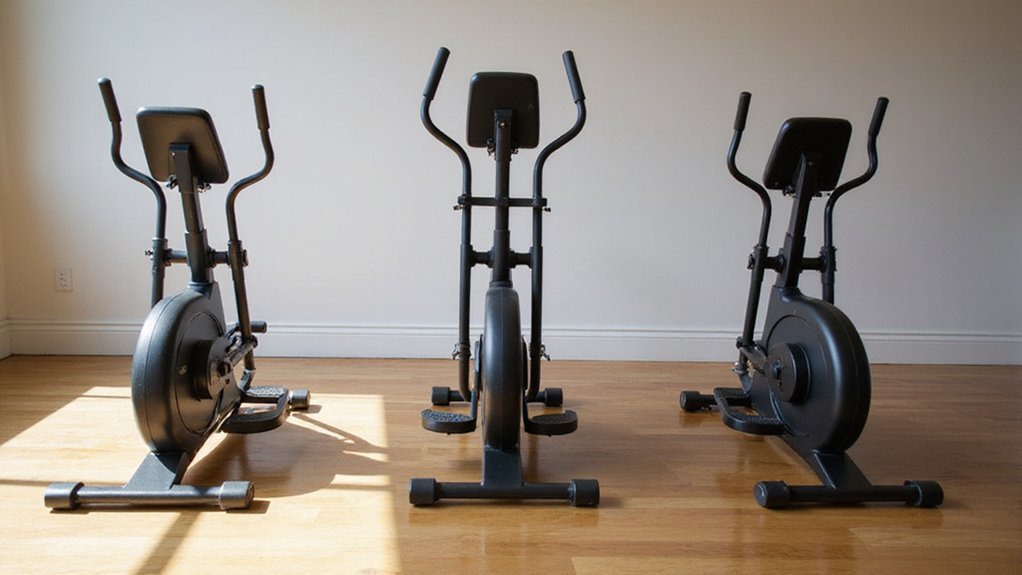
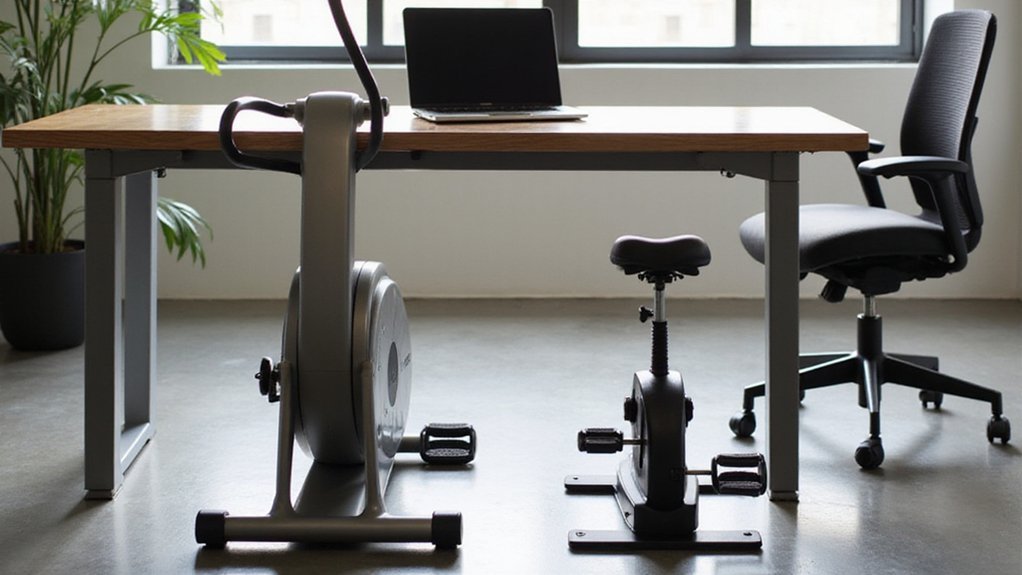
When you compare under‑desk ellipticals, the drive system—front, center, or rear—defines the machine’s footprint, noise level, and stride feel.
A front‑drive places the flywheel at the front, giving a short length (≈12‑14 in) and low step‑up height, but the motor’s proximity to the pedals raises noise and creates a “climbing” feel; many use a belt‑driven system that can feel less fluid at low speeds.
Center‑drive locates the flywheel on either side, shrinking the depth to ≈10‑12 in, delivering an oval stride with minimal lateral vibration and the quietest operation for office desks.
Rear‑drive mounts the flywheel behind you, extending the machine to ≈15‑18 in, offering longer stride length and smoother magnetic resistance, yet it demands extra desk clearance.
Choose front‑drive for cramped spaces, center‑drive for low noise and compact depth, and rear‑drive when you prioritize premium feel and have room behind the desk.
Key Features to Look For in an Under‑Desk Elliptical
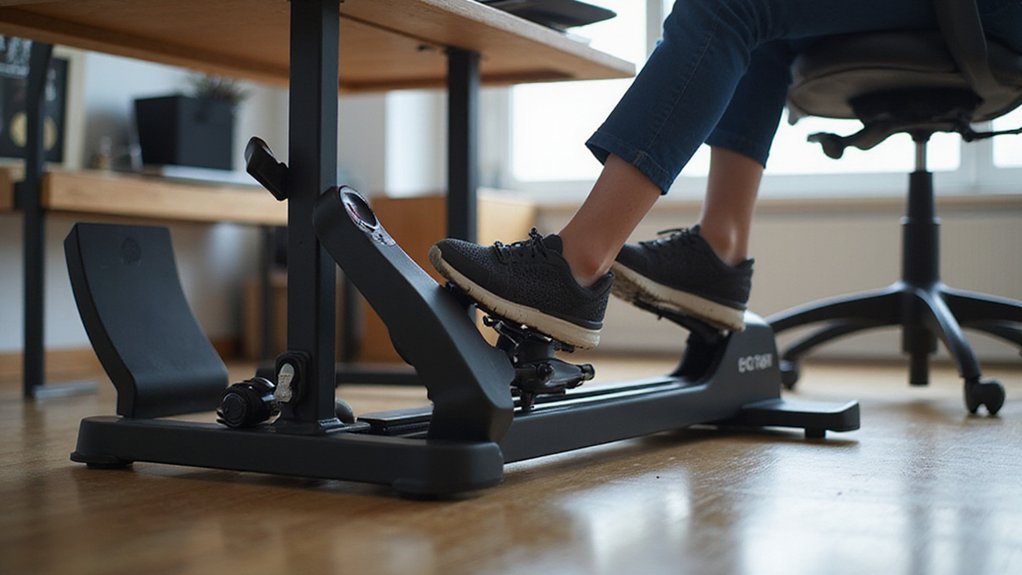
If you want an under‑desk elliptical that’s both safe and effective, start by checking the pedal design— the pedal design—lip pedals or non‑slip surfaces cut foot‑slip risk by up to 30 % compared with flat pads, giving you a stable platform for every stride.
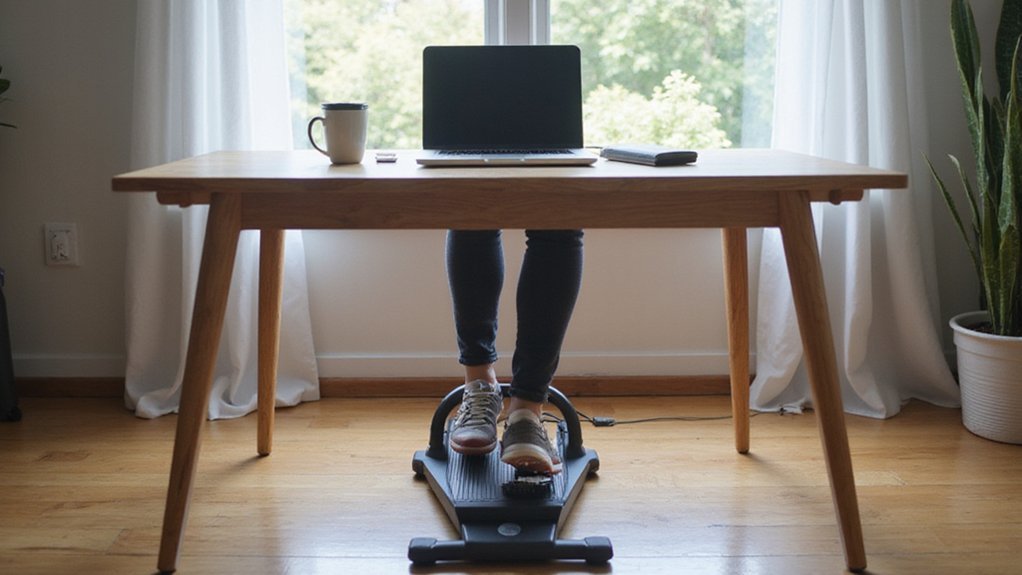
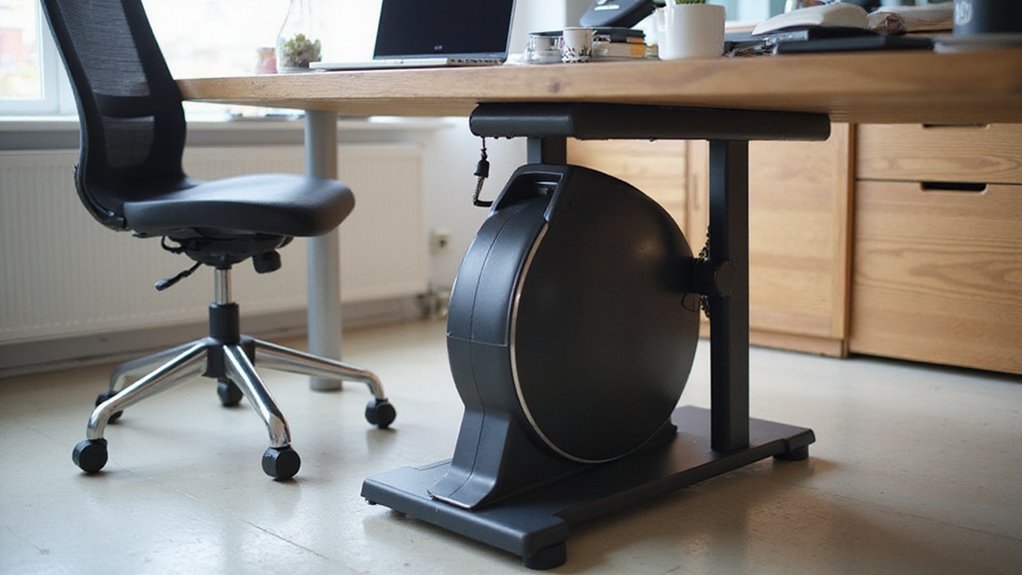
Next, compare the compact footprint; models around 15 × 12 in sit comfortably under most desks while a low step‑up height (≤ 6 in) preserves leg clearance.
Evaluate non‑slip pedals against ergonomic foot placement to reduce fatigue.
Look for adjustable resistance with at least four levels, because each step raises calorie burn by roughly 88 cal/hr.
Verify weight capacity—300 lb covers most users, higher ratings add safety.
Finally, choose a unit with a quiet drive system, remote control display, or base control that shows time, speed, and calories for real‑time feedback.
Matching Stride, Resistance, and Capacity for Your Under‑Desk Elliptical
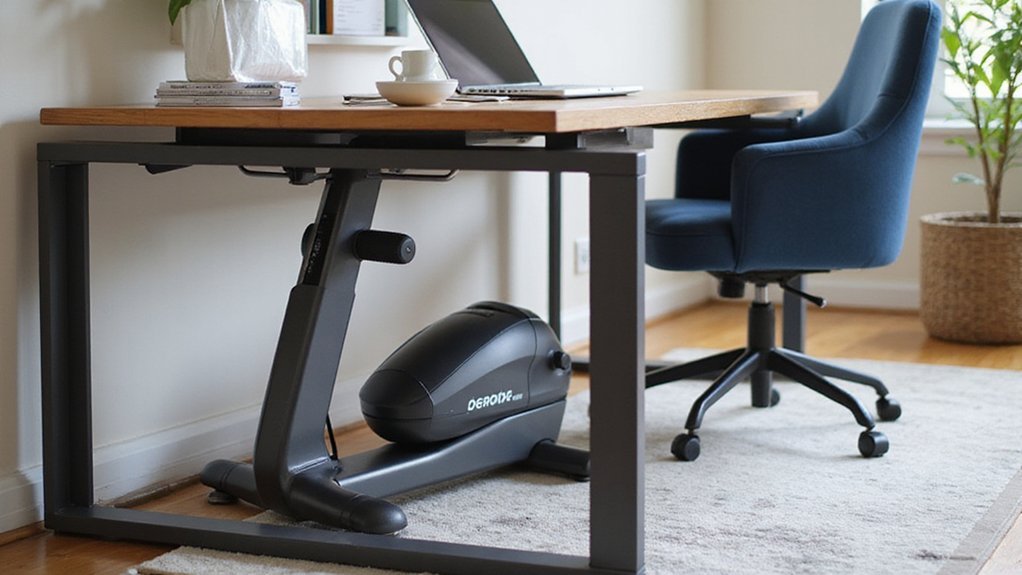
Pedal design, footprint, and quiet drive set the foundation, but the next step is aligning stride length, resistance levels, and weight capacity to your body and workout goals.
You’ll first compare stride length against your height: a 20‑inch travel suits most users, while 21‑22 inches keep hips neutral for anyone 5′8″ or taller.
Next, evaluate resistance levels; an under‑desk elliptical with at least 10 levels lets you sculpt interval workouts without sacrificing low‑impact feel.
Finally, confirm weight capacity exceeds your mass by roughly 30 lb to guarantee structural stability during prolonged seated sessions.
- Stride length – match to height for ergonomic comfort.
- Resistance levels – choose ≥10 for versatile incline range.
- Weight capacity – desk clearance and pedal design remain safe.
Common Mistakes to Avoid When Using an Under‑Desk Elliptical
Although an under‑desk elliptical seems low‑maintenance, overlooking a few fundamentals can quickly turn a convenient workout into a safety hazard.
First, you must place the unit on a non‑slip mat; without it, foot slippage can destabilize you and increase injury risk.
Second, respect the weight capacity—typically 300–350 lb—because exceeding it causes frame damage and motor wear.
Third, tall users should verify stroke length; a stride under 20 in forces cramped hip motion and adds knee stress.
Fourth, regular maintenance is essential: tighten cords, bolts, and pedal hinges to prevent noisy operation or sudden disengagement.
Finally, guarantee chair stability; a swiveling or unsupported chair can tip, compromising balance and undermining injury prevention.
Under‑Desk Elliptical Safety Checklist Before Riding
Before you start pedaling, make sure your workstation meets the safety standards that keep the workout effective and injury‑free.
First, confirm the desk provides at least 6‑inch clearance between your knees and the surface; insufficient clearance strains joints and limits stride length.
Second, test the non‑slip pedals with socks only—if foot slippage occurs, add a rubber mat or add a rubber with a front lip.
Third, perform a quick cord inspection and check all bolts for tightness; replace any frayed cables before each session.
- Verify clearance and seat position.
- Ensure non‑slip pedals prevent foot slippage.
- Conduct cord inspection and wear stable shoes.
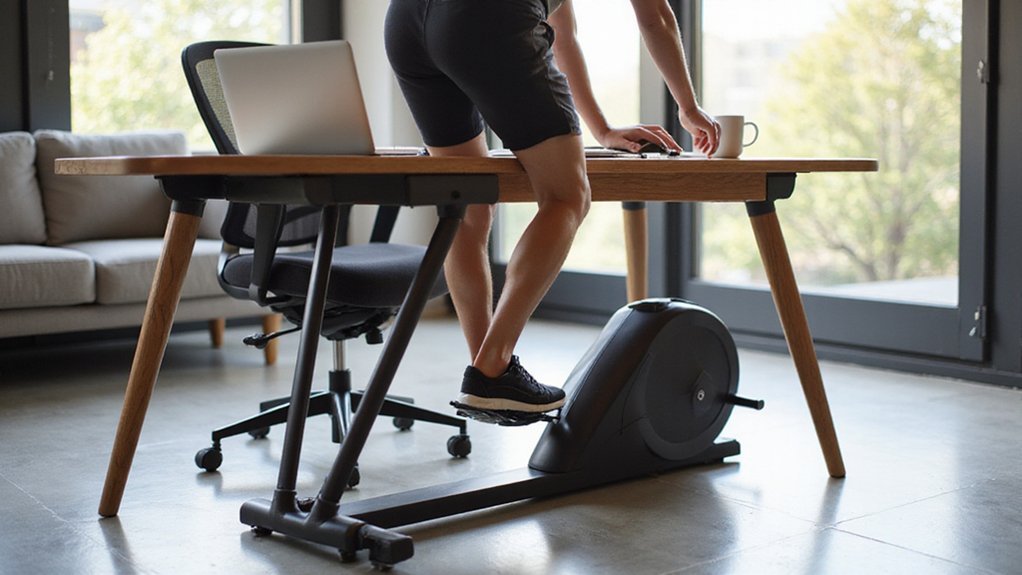
Limit standing use to models expressly designed for it, and consult a healthcare professional if you have joint issues or recent injuries.
Test Results: Top Under‑Desk Ellipticals Compared
Now that your workstation passes the safety checklist, let’s compare the performance of the leading under‑desk ellipticals.
The Sunny Health Smart Motorized model scores top‑tier ergonomics and solid exercise range, yet its lack of front‑lip pedals and minimal remote control screen limit lower‑body focus and calorie‑burn tracking.
Cubii Move balances ergonomics and convenience with wide, lip‑enhanced pedals, offering a portable design but a modest exercise range and no remote screen.
Cubii Go, a manual unit, mirrors Move’s ergonomics and convenience, adds a luggage handle and wheels, but its stroke resistance and calorie‑burn potential stay low.
Merach tops the exercise range chart, combines thick front‑lip pedals, a full‑metric remote control screen, and lightweight portability, delivering the most thorough lower‑body focus and highest calorie‑burn efficiency among the tested under‑desk ellipticals.
Choosing the Best Model for Your Space and Budget
When you measure your workspace, make sure the elliptical’s 30‑inch width has at least a 12‑inch clearance on each side and an 18‑inch gap behind it for pedal swing and cable routing; this simple check instantly narrows the options.
Next, compare models against your desk height clearance, foot clearance, and weight capacity.
A tight budget range forces trade‑offs: the Cubii Move stays under $200, offers adjustable resistance, but lacks front‑lip pedals; the Sunny Health Smart Motorized Mini ($160‑$250) adds a remote but also front‑lip safety. The Merach Under‑Desk Elliptical, though pricier, delivers excellent front‑lip pedals, higher weight capacity, and extended warranty coverage for daily low‑impact exercise.
- Verify space measurement and desk height clearance.
- Match budget range to feature set (resistance, pedals, warranty).
- Prioritize weight capacity and foot clearance for safety.
Conclusion
Pick the drive that fits your desk’s clearance and noise tolerance: front‑drive for tight spaces, center‑drive for quiet compactness, rear‑drive for longer stride and smoother magnetic resistance. Verify the pedals’ non‑slip lip, 15 × 12‑inch footprint, and ≤ 6‑inch step‑up, and guarantee the machine’s capacity exceeds your weight by about 30 lb. Prioritize at least four resistance levels and keep bolts, cords, and the mat tight to avoid instability and common misuse.